







55,00€
AVAILABLE FORMAT
Javier Viver's book Aurelia Immortal is based on a real scientific discovery about the regenerative capacity of the Aurelia jellyfish to construct a narrative between science, fiction, and contemporary art.
Set in the year 2046, the play invites reflection on human immortality, biotechnology, and the ethical and cultural consequences of endless life.
Aurelia Immortal is a work by artist Javier Viver, published by the University of Navarra Museum. The book explores the idea of human immortality from the intersection of contemporary art, science, and fiction.
The publication takes a real scientific discovery as its starting point. The Aurelia jellyfish has the ability to regenerate its cells and return to a juvenile state after completing its life cycle.
In December 2015, Chinese marine biology student He Jinru published a key study on the jellyfish Aurelia in the journal PLOS One. The finding was reported by National Geographic and attracted considerable international interest.
According to research, jellyfish can restart their life cycle indefinitely. This phenomenon makes them a unique case of biological immortality. Javier Viver uses this discovery as the conceptual basis for the project.
Based on this discovery, Viver constructs a narrative that combines scientific documentation and speculative fiction. The story is set in the year 2046, in a future marked by advances in biotechnology.
In this imagined context, humanity has developed a transhuman condition, capable of prolonging life indefinitely. The discovery of Aurelia is presented as a decisive moment in human history.
From this future perspective, the book raises essential questions. What does it mean to live without time limits? How does the relationship between humans, nature, and art change?
Aurelia Immortal offers a profound reflection on immortality, the human condition, and the ethical consequences of technology. Art becomes a critical space from which to consider these scenarios.
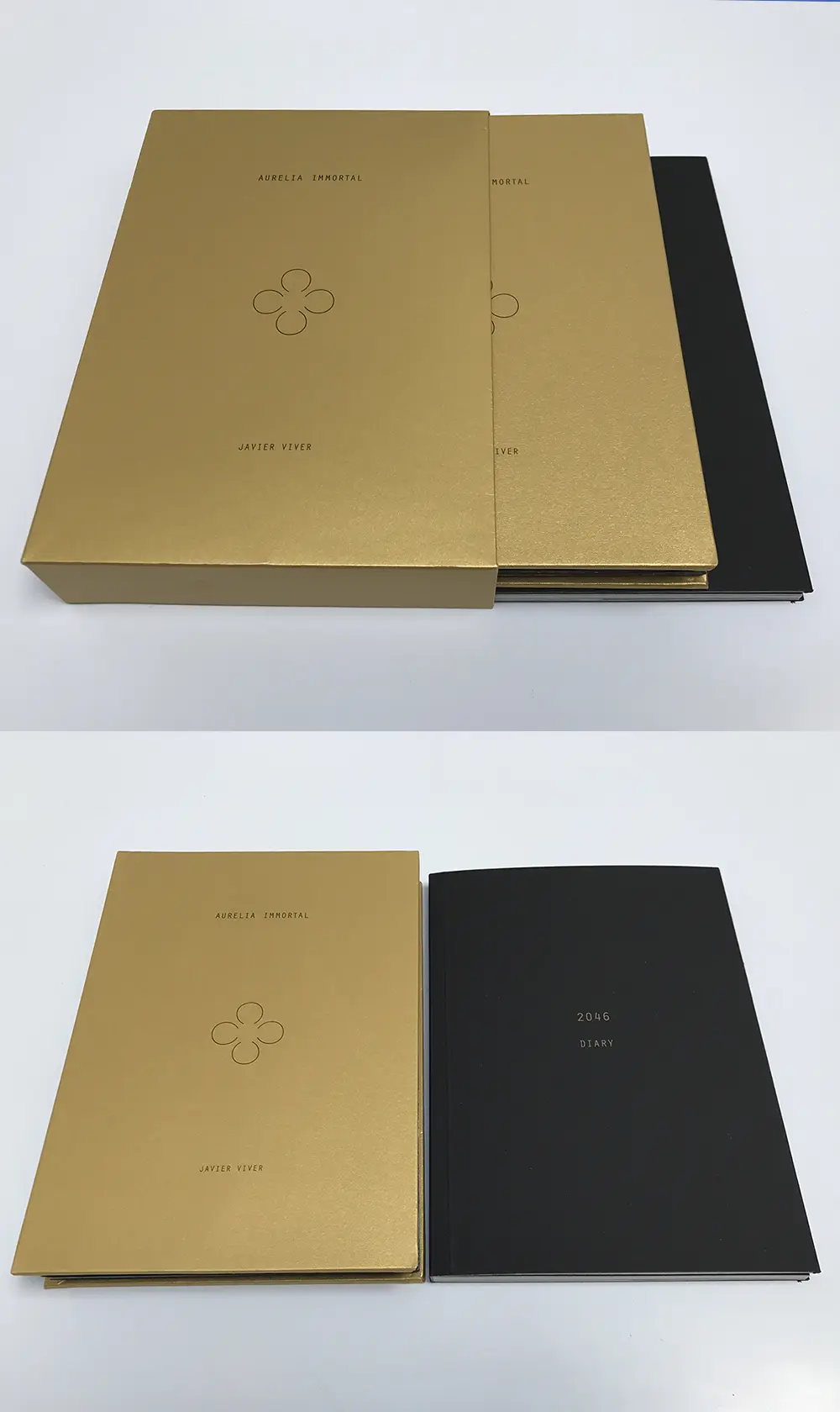
The book comes in a box set with two complementary volumes. The first brings together images of the Aurelia Immortal and its regeneration process.
This volume adopts a leporello format. Its magnetic covers allow the book to be closed in a circular shape, creating a visual narrative with no beginning and no end.
The second volume takes the form of a diary-agenda written in 2046. Its pages contain philosophical, scientific, and cultural questions arising from immortality.
With its careful design and innovative structure, Aurelia Immortal establishes itself as an essential work in the dialogue between art, science, and transhumanist thought.
The book invites the reader to question the limits of life, time, and artistic creation in a possible future.
| Weight | 1 g |
|---|---|
| Dimensions | 97.8 × 97.8 × 2.7 inches |

Orders over 350 €.

Credit card and PayPal

100% Happy customers 🥰

Orders over 350 €.